

Article: The Complete Guide to Cooling Shirts
The Complete Guide to Cooling Shirts
Cooling shirts sound simple until you start shopping for one.
Suddenly you are comparing terms like moisture-wicking, breathable, quick-dry, temperature-regulating, sweat-activated, UPF 50+, lightweight, performance fabric, four-way stretch, and cooling technology.
Some of those features overlap. Others solve completely different problems.
And that leads to the question this guide is designed to answer:
What actually makes a cooling shirt different, and how do you choose the right one?
A good cooling shirt should do more than feel thin when you first put it on. It should remain comfortable as heat, moisture, sun, humidity, movement, and changing temperatures become part of the day.
At Arctic Cool, that means combining sweat-activated temperature regulation with breathable construction, moisture management, quick-dry performance, lightweight stretch, and UPF 50+ protection where applicable.
This complete guide is part of the Arctic Cool Staying Cool Hub, our central resource for understanding heat, sweat, cooling apparel, fabric technology, outdoor activity, travel, work, and everyday warm-weather comfort.
Quick answer: The best cooling shirts combine lightweight breathable fabric, moisture-wicking performance, quick drying, comfortable stretch, and temperature-regulating technology. Some also provide UPF-rated coverage. The right shirt then depends on your preferred fit, sleeve coverage, activity, and how you want the shirt to look away from the heat.
What Is a Cooling Shirt?
A cooling shirt is performance apparel designed to help clothing feel more comfortable as heat, moisture, and movement build.
Not every cooling shirt works in exactly the same way.
Depending on the garment, cooling performance may involve:
- Moisture-wicking fabric
- Breathable construction
- Quick-dry fibers
- Evaporative cooling
- Sweat-activated technology
- Temperature-regulating fabric
- Lightweight construction
- Stretch that prevents restrictive movement
The important distinction is that “cooling” is not one single fabric property.
A useful cooling shirt combines several features that address what happens after your body gets warm.
How Do Cooling Shirts Work?
Your body naturally responds to heat by producing perspiration. When that moisture evaporates, it can help release heat.
Clothing can either support that process or make the experience feel less comfortable.
A heavy, absorbent shirt may hold moisture. A dense fabric may limit airflow. A restrictive fit may keep damp material pressed against the body.
Performance cooling apparel takes a different approach.
A well-designed cooling shirt may help:
- Move perspiration away from concentrated areas of the skin.
- Spread that moisture through the fabric.
- Allow air to move through or around the material.
- Support evaporation.
- Dry more efficiently after becoming damp.
- Remain flexible as the body moves.
For a deeper fabric-level explanation, read Cooling Fabrics Explained.
What Is Sweat-Activated Cooling?
Sweat-activated cooling uses moisture as part of the garment’s temperature-regulating process.
Instead of treating perspiration only as something that needs to be absorbed, sweat-activated technology is designed to put moisture and airflow to work together.
Arctic Cool apparel uses HydroFreeze X™, a sweat-activated temperature-regulating technology designed around the interaction between perspiration, fabric, airflow, movement, and evaporation.
When moisture reaches the fabric, the overall system is designed to support a cooler-feeling wearing experience as air moves across the material.
That does not mean the shirt stops your body from sweating, guarantees that you will never feel hot, or controls your body temperature to a specific number.
It means moisture becomes part of the fabric’s performance rather than simply something the shirt holds.
For the full process, read How Sweat-Activated Cooling Works.
What Is HydroFreeze X™?
HydroFreeze X™ is Arctic Cool’s sweat-activated temperature-regulating technology.
It is designed to work alongside several other fabric characteristics:
- Moisture management
- Airflow
- Evaporation
- Quick-dry performance
- Lightweight construction
- Stretch and mobility
Think of HydroFreeze X™ as part of a complete hot-weather fabric system rather than an isolated feature.
The practical goal is clothing that feels more comfortable when an ordinary day begins to include heat, sweat, humidity, walking, outdoor work, golf, travel, yard projects, errands, or long stretches outside.
Cooling vs. Moisture-Wicking: What Is the Difference?
Cooling and moisture-wicking are related, but they are not interchangeable terms.
Moisture-Wicking
Moisture-wicking fabric is designed to move perspiration away from the skin and distribute it through the garment.
This helps prevent moisture from remaining concentrated in one area and can support more efficient drying.
Cooling
Cooling or temperature-regulating technology may use moisture movement as one component of a broader system involving airflow, evaporation, fabric construction, and specialized technology.
A shirt can therefore be moisture-wicking without necessarily having sweat-activated temperature-regulating technology.
For a complete side-by-side explanation, read Cooling vs. Moisture-Wicking: What’s the Difference?.
What Does Breathability Mean in a Cooling Shirt?
Breathability describes how readily air and moisture can move through or around a fabric.
That becomes important once you are:
- Walking outside
- Playing golf
- Doing yard work
- Traveling
- Gardening
- Working in warm conditions
- Running errands
- Spending time in humidity
A shirt can be very lightweight but still feel uncomfortable if the fabric does not allow enough airflow.
That is why fabric weight and breathability should be considered separately.
What Does Quick-Dry Mean?
Quick-dry performance describes how efficiently fabric releases moisture after becoming damp.
This matters because most hot-weather days are not one continuous level of heat.
You may perspire while walking through a parking lot, cool down inside a store, get warm loading the car, sit in air conditioning, and then head outside again.
A quick-dry shirt is designed to recover more efficiently between those moments.
A simple way to remember the difference is:
- Wicking moves moisture.
- Breathability supports airflow.
- Quick-dry helps moisture leave the fabric.
- Sweat-activated technology uses moisture and airflow as part of temperature regulation.
Why Lightweight Fabric Matters
Lightweight fabric reduces unnecessary bulk, but lightweight alone does not automatically make a shirt good for hot weather.
A thin shirt can still:
- Hold moisture
- Dry slowly
- Have limited airflow
- Cling once damp
- Lack stretch
Look for lightweight construction alongside moisture management, breathability, quick drying, and comfortable movement.
Why Stretch Matters in a Cooling Shirt
Heat comfort is not only about temperature.
A shirt that pulls across your shoulders, waist, arms, or back can become distracting once the day becomes active.
Four-way stretch can support movement during:
- Walking
- Golf swings
- Pickleball
- Gardening
- Yard work
- Travel
- Driving
- Carrying bags
- Bending and reaching
The garment should move with the activity rather than forcing the activity to work around the garment.
What Does UPF 50+ Mean in Cooling Apparel?
UPF stands for Ultraviolet Protection Factor.
A UPF rating describes how much ultraviolet radiation can pass through the rated fabric to the skin it covers.
UPF 50 fabric allows approximately 1/50th of UV radiation to pass through, providing a high level of fabric sun protection for covered skin.
UPF and cooling are separate concepts.
A useful warm-weather shirt can combine UPF-rated coverage with lightweight, breathable, moisture-wicking, quick-dry construction.
Remember that a UPF rating only applies to the skin covered by the garment. Use sunscreen and other appropriate sun-protection practices on exposed skin.
Do Cooling Shirts Really Work?
Cooling shirts can provide meaningful fabric-level benefits, but realistic expectations matter.
A cooling shirt can be designed to:
- Move moisture more effectively than ordinary absorbent fabric
- Support airflow
- Dry efficiently
- Use moisture as part of a temperature-regulating process
- Reduce the heavy, damp feeling associated with slow-drying clothing
- Provide lightweight stretch for movement
- Provide UPF-rated fabric coverage where applicable
A cooling shirt cannot:
- Stop your body from sweating
- Make extreme heat disappear
- Guarantee that you will never feel warm
- Replace water, shade, breaks, or appropriate heat planning
- Protect exposed skin that is not covered by the garment
The best way to evaluate a cooling shirt is not whether it creates a dramatic effect while you are standing indoors.
Evaluate what the fabric does once you are actually warm, moving, sweating, and staying in the same shirt for several hours.
What Should You Look for in a Cooling Shirt?
When comparing shirts, look beyond the word “cooling.”
Consider the full system.
1. Temperature Regulation
Look for technology designed around real changes in heat, moisture, airflow, and movement.
2. Moisture-Wicking
The fabric should help distribute perspiration instead of allowing it to remain concentrated against the body.
3. Breathability
Airflow becomes increasingly important during humidity, movement, and longer periods outdoors.
4. Quick-Dry Performance
The shirt should recover efficiently after warm portions of the day.
5. Lightweight Construction
Avoid unnecessary fabric weight and bulk.
6. Stretch
The shirt should move through the shoulders, torso, and arms without restriction.
7. Appropriate Fit
Choose enough room for movement without creating excessive fabric that bunches or folds.
8. Appropriate Coverage
Decide whether your activity calls for short sleeves, 3/4 sleeves, long sleeves, or another silhouette.
9. UPF Protection When Relevant
If the day includes extended sun, consider UPF-rated fabric for covered areas.
10. Everyday Wearability
A useful performance shirt should fit into your actual life.
If you need to immediately change because the shirt looks like gym gear, it may be less useful for errands, travel, restaurants, work, or social plans.
How Should a Cooling Shirt Fit?
Fit can change the way performance fabric feels.
An extremely tight shirt may keep damp fabric pressed closely against the body.
An excessively loose shirt can create extra material that bunches during movement.
A good hot-weather fit should allow:
- Natural shoulder movement
- Comfortable arm movement
- Room through the torso appropriate to the style
- Comfort while sitting and driving
- Bending and reaching
- Airflow around the garment
Different activities and preferences call for different silhouettes, which is why there is no single universal cooling-shirt fit.
Best Cooling Shirt for Everyday Men’s Wear
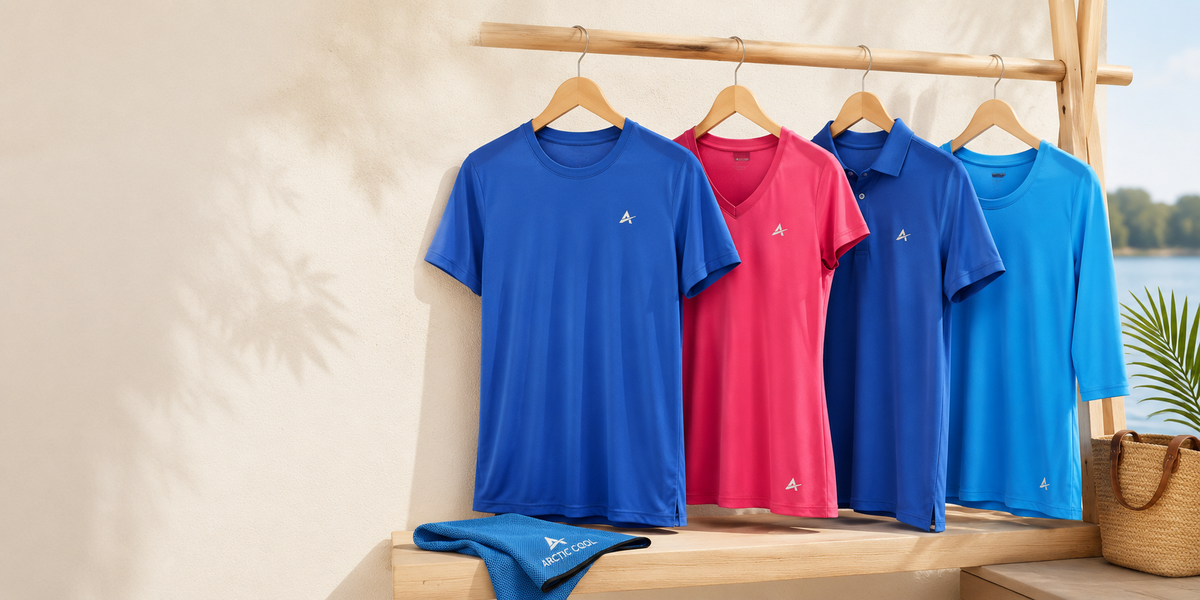
The Men’s Cooling Crew Neck T-Shirt is the core everyday men’s option.
It brings temperature-regulating performance into a familiar crew-neck silhouette rather than making the wearer look dressed exclusively for exercise.
It works well for:
- Walking
- Errands
- Travel
- Casual outdoor plans
- Backyard activities
- Light yard work
- Warm commutes
- Everyday summer wear
Choose the Men’s Crew If:
- You want an everyday T-shirt silhouette.
- You prefer short sleeves.
- You need one shirt for several different activities.
- You want performance without an overly athletic appearance.
Best Cooling Shirt for Everyday Women’s Wear
The Women’s Cooling V-Neck Short Sleeve T-Shirt serves the same everyday role for women.
The V-neck and short sleeves create an easy casual silhouette for:
- Errands
- Walking
- Travel
- Casual workdays
- Shopping
- Outdoor lunches
- Weekend routines
- Warm everyday life
Choose the Women’s V-Neck If:
- You prefer an open neckline.
- You want short-sleeve warm-weather coverage.
- You need a top that works beyond workouts.
- Your schedule combines indoor and outdoor activities.
Best Cooling Shirt for Golf and Polished Plans
The Men’s Cooling Polo brings the performance system into a more polished silhouette.
A polo can make more sense when the day includes:
- Golf
- Work
- Travel
- Restaurants
- Outdoor events
- Family gatherings
- Plans that continue after the activity
The goal is performance apparel that does not require choosing between technical fabric and a more refined look.
Choose the Cooling Polo If:
- You want a collar.
- You play golf.
- A basic tee feels too casual.
- You want performance that still looks polished.
Best Cooling Shirt for Lightweight Coverage
The Women’s Cooling 3/4 Sleeve T-Shirt provides more coverage without relying on a heavy traditional layer.
Its relaxed silhouette works particularly well for:
- Walking
- Travel
- Gardening
- Errands
- Outdoor markets
- Cool mornings that become warm afternoons
- Cold air conditioning followed by outdoor heat
- Late-summer and transitional weather
Choose the Women’s 3/4 Sleeve If:
- You want additional arm coverage.
- You prefer a relaxed, free-flowing silhouette.
- You regularly move between changing temperatures.
- You want coverage without immediately reaching for a heavy layer.
Where Does a Cooling Towel Fit?
A shirt and a cooling towel serve different roles.
The shirt is the continuous foundation of the outfit.
An Arctic Cool Cooling Towel can serve as an additional tool during specific hotter periods.
Keep one nearby for:
- Golf
- Outdoor sports
- Yard work
- Gardening
- Travel
- Long walks
- Outdoor work
- Hot cars or parking areas
- Peak afternoon heat
The towel does not need to replace the performance shirt. The two can serve complementary purposes during longer or hotter days.
Best Cooling Shirts for People Who Run Hot
If you regularly feel warmer than the people around you, prioritize clothing that remains comfortable after heat and perspiration become part of the day.
Look for:
- Lightweight construction
- Breathable fabric
- Moisture-wicking performance
- Quick drying
- Comfortable stretch
- A fit that does not feel restrictive
- A silhouette you can wear through normal daily activities
For more problem-specific guidance, read Best Shirts for People Who Overheat Easily.
Best Cooling Shirts for Hot Weather
When the main problem is simply hot weather, start by evaluating the conditions.
Ask:
- Is the heat dry or humid?
- Will you be walking or sitting?
- Will you be in direct sun?
- How long will you remain outside?
- Do you need a casual or polished shirt?
- Do you want more or less sleeve coverage?
- Will you need the same shirt afterward?
Then choose the silhouette that matches the activity rather than assuming every performance shirt is interchangeable.
For product-by-product shopping guidance, visit Best Cooling Shirts for Hot Weather.
Best Cooling Shirts for Humid Weather
Humidity makes clothing performance especially noticeable because moisture may evaporate more slowly.
Prioritize:
- Breathability
- Moisture movement
- Quick drying
- Lightweight construction
- A comfortable non-restrictive fit
A shirt that simply feels thin while dry may not perform well once moisture builds.
Best Cooling Shirts for Walking
Walking creates steady heat over time.
Choose a lightweight Crew, V-Neck, or 3/4 Sleeve that feels natural enough for the complete routine, including errands, sightseeing, travel, or lunch afterward.
Walking shirts should prioritize:
- Breathability
- Quick drying
- Comfortable stretch
- Everyday styling
- A fit that remains comfortable over longer routes
Best Cooling Shirts for Golf
Golf combines walking, standing, sitting, swinging, sun exposure, and several hours outside.
A Cooling Polo is the natural choice when you want:
- A collar
- Stretch through the swing
- Breathability
- Moisture management
- A shirt that still works in the clubhouse or at lunch
Best Cooling Shirts for Yard Work and Outdoor Projects
Outdoor projects place more emphasis on bending, lifting, carrying, reaching, and repeated movement.
Look for:
- Four-way stretch
- Room through the shoulders and torso
- Moisture-wicking performance
- Quick drying
- Coverage appropriate for the task
- A Cooling Towel for hotter breaks or longer projects
Always choose clothing appropriate for the equipment and work being performed.
Best Cooling Shirts for Travel
Travel exposes one outfit to several completely different environments.
You may move through:
- A warm parking lot
- An air-conditioned airport
- A cold airplane cabin
- A hot rental-car lot
- Outdoor sightseeing
- Restaurants
- Long periods of sitting
- Several miles of walking
Choose a shirt that manages heat but still looks appropriate once you arrive.
The Men’s Crew and Women’s V-Neck provide simple everyday foundations. The Women’s 3/4 Sleeve can make sense when changing temperatures and air conditioning are a major concern.
Cooling Shirts vs. Cotton Shirts
Cotton can feel soft and familiar, but it may hold moisture and become heavier as perspiration builds.
Performance cooling fabrics are designed differently.
The objective is to:
- Move moisture rather than simply hold it
- Support airflow
- Dry more efficiently
- Remain flexible during movement
- Support temperature regulation where specialized technology is used
This difference becomes most noticeable after the shirt gets warm or damp, not necessarily when both shirts are clean and dry.
Cooling Shirts vs. Regular Athletic Shirts
Many athletic shirts are lightweight and moisture-wicking, but that does not automatically mean they use sweat-activated temperature-regulating technology.
They may also be styled primarily for workouts.
Arctic Cool’s current direction is to bring performance into more familiar everyday silhouettes:
- Classic Crew Neck
- Women’s V-Neck
- Polished Polo
- Relaxed 3/4 Sleeve
The goal is apparel you can use when heat is part of ordinary life, not only structured exercise.
How Many Cooling Shirts Do You Need?
Start with the number of hot-weather situations that regularly appear in your week.
Simple Men’s Rotation
- Two Men’s Cooling Crews for everyday wear
- One Cooling Polo for golf, work, travel, or polished plans
- One additional work or activity-focused style if needed
Simple Women’s Rotation
- Two Women’s Cooling V-Necks for everyday wear
- One Women’s 3/4 Sleeve for coverage and changing temperatures
- One additional activity or sleeve-length option based on the routine
Add a Cooling Towel when your schedule frequently includes prolonged outdoor activity.
How to Care for Cooling Shirts
Performance fabrics should be cared for according to the instructions on the garment label and individual product page.
In general, avoid treating a technical performance shirt exactly like a heavy cotton tee.
Pay attention to:
- Recommended wash temperature
- Drying instructions
- Fabric-softener restrictions
- Bleach instructions
- Ironing restrictions
Proper care helps preserve the fabric characteristics you purchased the shirt for in the first place.
Common Cooling-Shirt Shopping Mistakes
Choosing Only by Fabric Thickness
The thinnest shirt is not automatically the most breathable or fastest drying.
Assuming Moisture-Wicking Means Cooling
Wicking is an important feature, but it is not identical to sweat-activated temperature regulation.
Ignoring Fit
Even strong fabric technology can feel uncomfortable when the silhouette does not fit your body or activity.
Buying Only for Exercise
If most of your heat exposure happens during errands, travel, walking, work, gardening, or everyday life, choose apparel you will realistically wear in those environments.
Expecting Clothing to Replace Heat Planning
Performance apparel can support comfort, but water, shade, breaks, sunscreen, appropriate equipment, and attention to conditions still matter.
How to Choose Your Arctic Cool Cooling Shirt
Use this simple decision process.
Choose the Men’s Cooling Crew When:
- You want a familiar everyday tee.
- You walk, travel, run errands, or spend casual time outside.
- You prefer short sleeves and a crew neckline.
Choose the Women’s Cooling V-Neck When:
- You want a versatile short-sleeve everyday top.
- You prefer an open V-neckline.
- Your routine includes errands, travel, walking, and casual plans.
Choose the Men’s Cooling Polo When:
- You golf.
- You want a collar.
- You need a more polished warm-weather shirt.
- You move between activity, work, travel, meals, and social plans.
Choose the Women’s 3/4 Sleeve When:
- You prefer more arm coverage.
- You want a relaxed silhouette.
- You move between cool mornings, air conditioning, and warm afternoons.
- You garden, walk, travel, or spend time outdoors.
Add a Cooling Towel When:
- You regularly spend extended periods outside.
- You golf or play outdoor sports.
- You do yard work or outdoor projects.
- You travel in hot conditions.
- You want an additional tool available during hotter periods.
Start With the Complete Performance System
The best cooling shirt is not defined by one buzzword.
It is the combination of features that matters.
Look for moisture movement, airflow, quick drying, lightweight construction, stretch, an appropriate fit, useful coverage, and temperature-regulating technology when that is part of the garment.
Then choose the silhouette that actually fits your life.
The Men’s Cooling Crew brings performance into an everyday tee. The Women’s Cooling V-Neck provides an easy short-sleeve option. The Men’s Cooling Polo adds polish for golf, work, and plans. The Women’s 3/4 Sleeve provides lightweight coverage for changing temperatures. A Cooling Towel can add extra support during the hotter parts of an outdoor day.
That is ultimately what cooling apparel should do: make performance useful in real life.
For more education, product comparisons, activity guides, travel advice, outdoor-work content, and customer stories, continue exploring the Arctic Cool Staying Cool Hub.
Frequently Asked Questions
What is a cooling shirt?
A cooling shirt is performance apparel designed to help clothing feel more comfortable as heat and moisture build. Depending on the shirt, it may combine moisture-wicking, breathability, quick-dry fabric, lightweight stretch, evaporative cooling, or sweat-activated temperature-regulating technology.
How do sweat-activated cooling shirts work?
Sweat-activated cooling shirts use moisture and airflow as part of the fabric’s temperature-regulating process. Arctic Cool’s HydroFreeze X™ technology is designed to work as perspiration, fabric, movement, airflow, and evaporation interact.
Is moisture-wicking the same as cooling?
No. Moisture-wicking describes how fabric moves perspiration away from the skin. Cooling or temperature-regulating technology may use moisture movement along with airflow, evaporation, and specialized fabric technology as part of a broader performance system.
What should I look for in a cooling shirt?
Look for lightweight breathable fabric, moisture-wicking performance, quick drying, comfortable stretch, an appropriate fit, and temperature-regulating technology. UPF-rated fabric can also be useful when the shirt will be worn in direct sun.
Can a cooling shirt prevent sweating or overheating?
No. A cooling shirt does not prevent the body from sweating or guarantee that you will never become hot. Performance apparel can support comfort and moisture management, but it does not replace water, shade, breaks, appropriate sun protection, or other heat-planning practices.

Leave a comment
This site is protected by hCaptcha and the hCaptcha Privacy Policy and Terms of Service apply.