

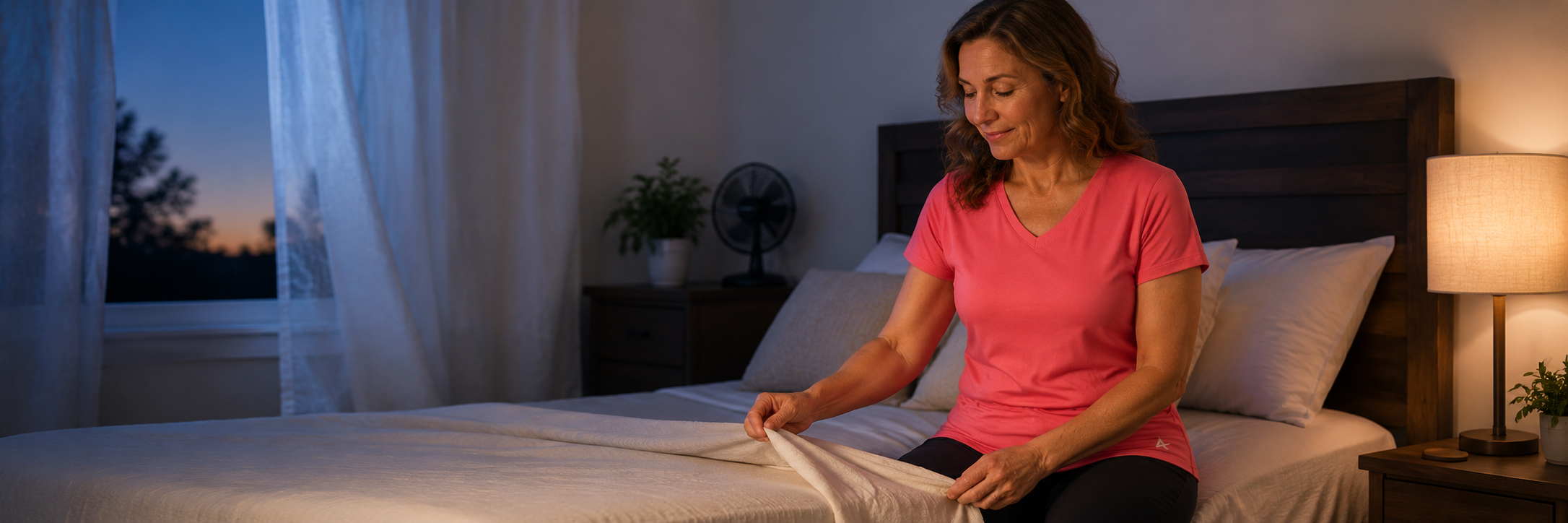
Why Do I Overheat at Night? Clothing and Fabric Factors That Matter
You turn down the thermostat, remove a blanket, and still wake up feeling too warm.
Sometimes the explanation is straightforward: the room retained heat from the day, the bedding is heavier than expected, or several layers are creating a warm pocket of air around the body. In other cases, perspiration makes clothing damp, and that moisture remains trapped between the skin, shirt, sheets, and mattress.
Clothing and bedding can strongly influence nighttime comfort, but they do not explain every episode of overheating or sweating. Hot flashes, medications, illness, sleep conditions, and other health factors may also play a role.
This article focuses on the factors you can evaluate without trying to diagnose the cause: room temperature, airflow, humidity, bedding, garment weight, fit, breathability, moisture movement, and drying speed.
This guide is part of the Arctic Cool Staying Cool Hub, our central resource for heat, perspiration, breathable fabrics, temperature regulation, and real-life comfort.
Quick answer: You may feel too hot at night because the room, bedding, clothing, humidity, and limited airflow create a warm environment around your body. Choose lightweight, breathable clothing, reduce unnecessary layers, use bedding that can be adjusted easily, and pay attention to whether damp fabric dries or remains against your skin.
Feeling Warm at Night Is Not Always the Same as Night Sweats
It is helpful to separate two experiences that are often described with the same words.
Environmental Nighttime Overheating
You may feel warm because:
- The bedroom retained heat from the afternoon.
- The room has poor airflow.
- Humidity is high.
- The mattress and bedding create a warm sleeping environment.
- Your clothing is heavy, tight, or layered.
- The fabric absorbs perspiration and stays damp.
- You share bedding or body heat with another person or pet.
In these situations, changing the room, clothing, or bedding may improve comfort.
Recurring Night Sweats
Night sweats generally involve repeated episodes of significant sweating during sleep, sometimes enough to leave clothing or bedding noticeably wet.
Clothing can affect how that moisture feels, but it may not be the cause. Hot flashes, medications, fever, health conditions, and other factors can contribute to nighttime sweating.
Speak with a healthcare professional when the sweating is new, persistent, drenching, disruptive, or accompanied by other symptoms.
Why the Bedroom Can Feel Hotter Than Expected
The thermostat shows the temperature of the room. It does not show the exact conditions underneath your clothing and bedding.
Your body, shirt, sheets, blanket, mattress, and surrounding air create a smaller thermal environment. Even when the room feels manageable while you are standing, that enclosed space can become warmer after you lie down.
Factors include:
- How many layers are above and below you
- How heavy those layers are
- Whether air can move through them
- How closely clothing fits the body
- Whether fabric becomes damp
- How efficiently the moisture can evaporate
- Whether the room air is humid or still
A bedroom that feels comfortable before bed can also warm during the night when doors and windows are closed and airflow decreases.
Clothing Factor 1: Fabric Weight
Fabric weight is one of the most noticeable nighttime comfort factors.
A shirt can be described as soft or breathable and still contain more material than you need for a warm room. Thick collars, dense fabric, long sleeves, ribbed cuffs, and multiple layers can all add warmth.
For warm evenings, consider:
- A lightweight short-sleeve top
- A sleeveless top when less coverage feels comfortable
- Lightweight shorts or loose bottoms
- One layer rather than a shirt plus sweatshirt
- A garment without heavy trim or dense panels
The lightest-looking garment is not automatically the best choice. Fabric construction, fit, moisture movement, and drying speed matter too.
Clothing Factor 2: Breathability
Breathability describes how readily air can move through and around a fabric.
A breathable shirt may feel less enclosed than a dense garment, especially when the room is warm or the sleeper begins perspiring.
Breathability is influenced by:
- The structure of the fabric
- The density of the knit or weave
- The garment’s weight
- The number of layers
- The fit around the chest, back, arms, and neckline
- How much of the shirt is pressed beneath the body
A loose shirt cannot create airflow when it is trapped beneath several heavy blankets. Clothing and bedding need to work together.
Clothing Factor 3: Moisture-Wicking Performance
Perspiration is part of the body’s temperature-regulation process. The clothing question is what happens to the moisture after it reaches the shirt.
Moisture-wicking fabric is designed to move perspiration away from a concentrated area and distribute it through the material.
This can help reduce the feeling of one wet patch sitting directly against the skin. It does not prevent perspiration or guarantee that the shirt will remain completely dry.
Learn more in Cooling vs. Moisture-Wicking.
Clothing Factor 4: Drying Speed
Absorbing moisture and drying efficiently are not the same thing.
A fabric may take in perspiration but remain damp for a long time. During sleep, that damp material may cling to the back, chest, neck, or shoulders, especially where the body presses against the mattress.
Quick-dry fabric is useful when:
- You perspire during the first part of the night.
- The room is humid.
- Airflow is limited.
- You do not want to change shirts during the night.
- You frequently wake with fabric clinging to the skin.
For a deeper look at humidity, moisture movement, and fabric construction, read The Best Fabric for Hot and Humid Weather.
Clothing Factor 5: Fit
Very tight clothing can reduce the space available for air to move around the body. It may also feel more noticeable once the fabric becomes damp.
Extremely oversized clothing is not always better. Excess fabric can twist, bunch beneath the body, or add unnecessary weight.
Look for a fit that:
- Allows comfortable movement
- Does not pull across the chest or shoulders
- Does not feel restrictive around the neckline
- Does not create large folds beneath the body
- Feels comfortable while lying on your back or side
Fit preference is personal. The goal is not a specific silhouette—it is avoiding clothing that feels restrictive or cumbersome once you settle into bed.
Is Cotton Always the Best Fabric for Sleeping Hot?
Cotton is familiar, soft, and can feel breathable while it is dry. It also absorbs moisture.
For someone who does not perspire heavily, a lightweight cotton shirt may feel comfortable. For someone whose shirt becomes noticeably damp, cotton may hold that moisture longer than a quick-drying performance fabric.
The better question is not simply, “Is this cotton or synthetic?”
Ask:
- How heavy is the fabric?
- How breathable is the construction?
- Does it move moisture?
- How quickly does it dry?
- Does it cling when damp?
- Is the fit comfortable while lying down?
Not all synthetic fabrics perform the same way. A dense, non-breathable synthetic garment may feel very different from a lightweight performance shirt engineered for airflow and moisture movement.
How Bedding Changes the Equation
A lightweight shirt can still feel warm beneath heavy bedding.
Evaluate the complete setup:
- Fitted sheet
- Top sheet
- Blanket
- Comforter or duvet
- Mattress protector
- Pillow and pillowcase
- Extra throws at the foot of the bed
Use Layers You Can Adjust Easily
Several lightweight bedding layers can be easier to adjust than one heavy comforter. You can fold down one layer without removing everything.
Do Not Ignore What Is Beneath You
Heat does not come only from the blankets above the body. The mattress, protector, fitted sheet, and clothing pressed beneath the back can affect how warm and damp you feel.
Keep a Dry Change Nearby
If you regularly wake with a damp shirt, keep a clean lightweight top within reach. Changing into dry clothing may feel more comfortable than trying to return to sleep in saturated fabric.
How Humidity Affects Nighttime Comfort
Perspiration feels most useful when it can evaporate. Humid air slows that process.
In a humid bedroom:
- Skin may remain damp longer.
- Clothing may dry more slowly.
- Sheets may feel clammy.
- A fan may move air without fully resolving the moisture.
- Several layers may feel warmer than the room temperature suggests.
Reduce unnecessary layers, use breathable fabric, and improve airflow when practical. When outdoor air is more humid or hotter than the bedroom, opening a window may not improve comfort.
How Airflow Affects Clothing Performance
Breathable and quick-drying fabrics work best when moisture has somewhere to go.
Airflow can come from:
- A ceiling fan
- A tabletop or floor fan
- An open bedroom door
- Cross-ventilation when outdoor conditions are cooler
- Space between the bed and surrounding furniture
- Reducing heavy bedding around the torso
A fan should be positioned for comfortable circulation rather than an unpleasantly strong stream of air directly against the face.
For broader warm-home strategies, add a link to How to Stay Cool Without AC once that article has its confirmed Shopify URL.
What to Wear When You Feel Hot at Night
A simple nighttime clothing formula may include:
- One lightweight short-sleeve or sleeveless top
- Loose lightweight shorts or bottoms
- No unnecessary undershirt
- No heavy socks unless needed for comfort
- A removable light layer nearby rather than worn all night
Choose clothing based on the warmest point of the night. It is easier to pull up a light sheet than to remove several clothing layers after waking hot.
Can an Arctic Cool Shirt Be Worn at Night?
Arctic Cool shirts are designed as everyday performance apparel rather than specialized sleepwear.
Some people may find a lightweight performance tee comfortable while relaxing at home or sleeping, particularly if they prefer a familiar T-shirt silhouette. Others may prefer traditional pajamas, a tank, or no top at all.
The Women’s Short Sleeve Cooling V-Neck provides a lightweight everyday option with an open neckline, moisture-wicking performance, quick-dry fabric, and comfortable stretch.
The Men’s Cooling Crew Neck T-Shirt provides a familiar crew-neck shape with a fit designed to allow comfortable active movement.
Choose a clean shirt, follow the care instructions, and use the product only when its fit and fabric feel comfortable for you while lying down.
How HydroFreeze X™ Fits Into the Fabric Story
Arctic Cool apparel uses HydroFreeze X™, a sweat-activated temperature-regulating technology designed to work as moisture and airflow interact with the fabric.
The system combines:
- Moisture movement
- Breathable construction
- Quick-dry performance
- Lightweight stretch
- A sweat-activated cooling sensation
These apparel features may support clothing comfort when someone feels warm or begins perspiring. They do not identify why someone is overheating and cannot prevent or treat night sweats, hot flashes, fever, or another medical condition.
Learn more through the Arctic Cool Technology page and How Sweat-Activated Cooling Works.
A Nighttime Comfort Test
Changing everything at once can make it difficult to identify what is causing the discomfort.
Test one factor at a time.
Night 1: Reduce One Bedding Layer
Remove the heaviest blanket or fold it toward the foot of the bed.
Night 2: Change the Shirt
Replace a thick, tight, or slow-drying top with a lightweight, breathable option.
Night 3: Improve Airflow
Use a fan, open the bedroom door, or ventilate when outdoor conditions are cooler and appropriate.
Night 4: Evaluate Humidity
Notice whether the room feels damp and whether clothing or sheets remain wet for a long time.
Night 5: Simplify the Complete Setup
Use one lightweight clothing layer and bedding that can be adjusted easily.
Keep brief notes about room conditions, clothing, bedding, perspiration, and how often you wake. That information may also be helpful if you decide to speak with a healthcare professional.
When Clothing Is Probably Not the Whole Explanation
Clothing and bedding are worth evaluating, but they should not be used to explain away symptoms that are new, severe, or recurring.
Consider speaking with a healthcare professional when you:
- Repeatedly wake with soaked clothing or bedding
- Experience nighttime sweating in a comfortably cool room
- Have symptoms that began after starting or changing medication
- Also have fever or unexplained weight loss
- Experience significant daytime sweating or heat intolerance
- Have symptoms that regularly interrupt sleep
- Feel concerned even when no other symptom is present
A healthcare professional can consider factors that clothing advice cannot evaluate.
What to Avoid When You Sleep Hot
- Several unnecessary clothing layers
- Thick sweatshirts or dense lounge tops
- Tight shirts that become restrictive when damp
- Heavy bedding that cannot be adjusted easily
- Assuming a soft fabric will also dry quickly
- Judging fabric only by whether it is natural or synthetic
- Ignoring humidity and airflow
- Using clothing as a substitute for medical guidance
- Assuming all recurring night sweats are caused by a warm room
A Better Nighttime Fabric Checklist
Before choosing a top for a warm night, ask:
- Is the fabric lightweight?
- Can air move through it?
- Does the neckline feel open and comfortable?
- Does the fit allow movement without excessive bunching?
- Will the fabric move moisture?
- Does it dry efficiently after becoming damp?
- Does it remain comfortable against the skin?
- Does it work with the weight of my bedding?
For additional general guidance, explore Best Clothes for Hot Weather and Why Do I Overheat So Easily?.
Start With the Factors You Can Change
Nighttime overheating can be influenced by several small factors working together.
A warm room, still air, humid conditions, heavy bedding, a tight shirt, and slow-drying fabric may each add a little discomfort. Together, they can make it difficult to settle down or remain asleep.
Begin with the simplest changes: reduce unnecessary layers, choose lightweight breathable clothing, use bedding that can be adjusted easily, improve airflow, and pay attention to how fabric behaves after it becomes damp.
Those steps may improve environmental comfort. They should not be treated as a diagnosis or a replacement for medical care when nighttime sweating is persistent, drenching, new, or concerning.
Frequently Asked Questions
Why do I feel hotter at night than during the day?
Your clothing, bedding, mattress, room temperature, humidity, and airflow create a warm environment around your body while you sleep. Body-related factors can also contribute, so clothing may be only one part of the explanation.
What fabric is best if I sleep hot?
Look for lightweight, breathable fabric with moisture-wicking and quick-dry performance. Fabric weight, construction, fit, and drying speed are often more useful considerations than choosing by fiber name alone.
Is cotton the best fabric for hot sleepers?
Lightweight cotton may feel soft and breathable while dry, but it can absorb perspiration and remain damp. People who sweat at night may prefer a fabric that combines breathability with faster moisture movement and drying.
Can a cooling shirt stop night sweats?
No. A cooling shirt may support clothing comfort through breathability, moisture management, and quick drying, but it cannot prevent or treat night sweats, hot flashes, fever, or another medical condition.
When should I talk to a healthcare professional about night sweats?
Seek medical guidance when nighttime sweating is new, recurring, drenching, regularly disrupts sleep, begins after a medication change, or occurs with symptoms such as fever or unexplained weight loss.


Leave a comment
This site is protected by hCaptcha and the hCaptcha Privacy Policy and Terms of Service apply.