


How to Layer for Hot Days and Cold Air Conditioning
Summer layering can feel like a problem with no perfect answer.
Outside, the parking lot is hot, the car has been sitting in the sun, and even a short walk can make a heavy layer feel unnecessary. Then you step into an office, restaurant, grocery store, airport, or movie theater where the air conditioning feels dramatically colder.
A few hours later, you may be back outside carrying the sweater or jacket you needed indoors.
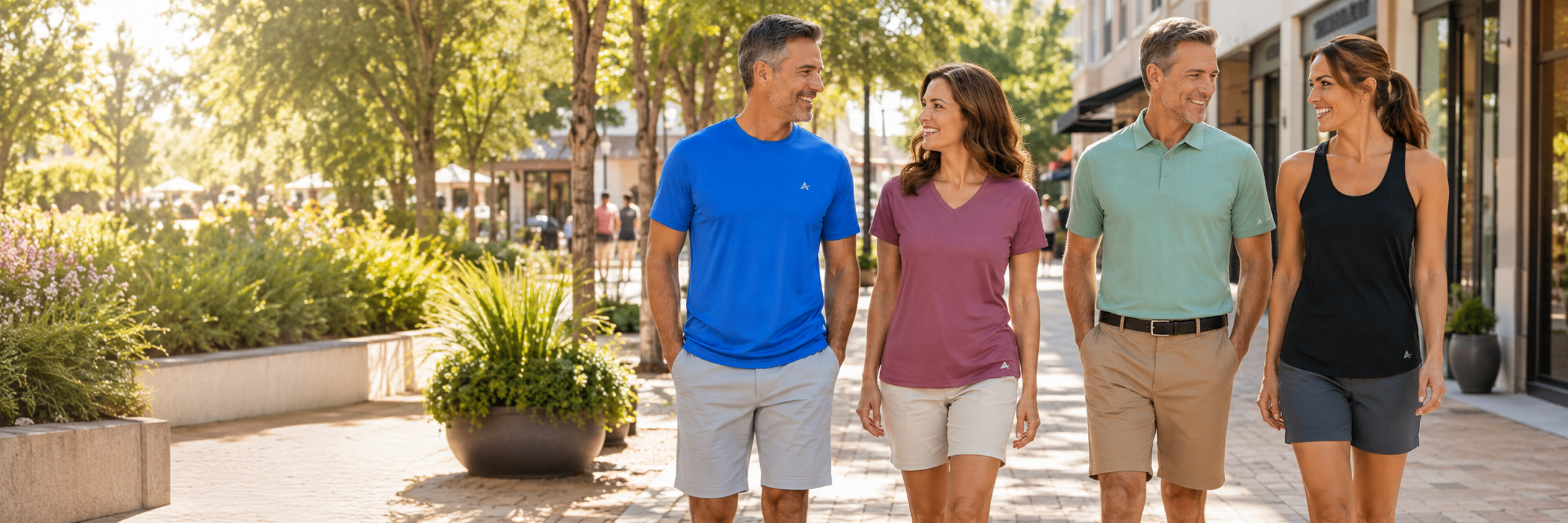
The solution is not to dress entirely for the coldest room or the hottest sidewalk. It is to build a lightweight indoor-to-outdoor outfit that can adjust without adding unnecessary bulk.
That usually means starting with a breathable hot-weather shirt, choosing the right sleeve coverage, and carrying only one removable layer when the indoor temperature requires it.
This guide is part of the Arctic Cool Staying Cool Hub, our central resource for practical comfort through heat, humidity, travel, work, errands, outdoor activity, and everyday life.
Quick answer: Dress primarily for the outdoor heat. Begin with a lightweight, breathable, moisture-wicking shirt that can remain comfortable outside. Choose a 3/4 sleeve or lightweight long sleeve when you want built-in coverage, or carry one thin removable layer for colder indoor spaces. Avoid stacking several heavy pieces that become difficult to manage once you return outside.
Why Hot Weather and Cold Air Conditioning Are Difficult to Dress For
Most outfits are selected for one general temperature. Indoor-to-outdoor summer days may involve several.
A normal schedule can include:
- A warm car or public transportation
- A sunny parking lot
- A cold office or classroom
- An air-conditioned restaurant
- Outdoor errands between stores
- A chilly airport terminal or airplane cabin
- A hotel, museum, or theater with strong air conditioning
- A warm drive home during the afternoon
The clothing needs to adjust without requiring a complete outfit change every time the environment changes.
This problem is especially noticeable in late summer. Retail displays may be shifting toward fall, but outdoor conditions may still be hot and humid. A thick sweater may feel comfortable at a desk but become a burden as soon as you walk back to the car.
The Three-Part Summer Layering Formula
A practical summer layering system can be built around three decisions:
- Choose a breathable main shirt for the warmest environment.
- Use sleeve length to create adaptable coverage.
- Carry no more than one lightweight removable layer.
The outdoor temperature should usually guide the foundation of the outfit because removing a heavy base shirt is much harder than adding a light layer indoors.
Step 1: Start With a Breathable Hot-Weather Foundation
The main shirt should be comfortable in the warm car, parking lot, sidewalk, and outdoor parts of the day.
Look for:
- Lightweight fabric
- Breathable construction
- Moisture-wicking performance
- Quick-dry comfort
- Stretch through the shoulders and torso
- A fit that does not become overly clingy
- A silhouette appropriate for the places you are visiting
A thick base layer may keep you comfortable in strong air conditioning, but it can trap warmth and moisture when you return outside. A breathable performance foundation gives you more flexibility.
For a broader explanation of fabric weight, airflow, fit, and moisture management, read Best Clothes for Hot Weather.
Step 2: Use Sleeve Length as Part of the Layering System
Layering does not always mean wearing several garments at once.
Sometimes the easiest solution is choosing one shirt with enough coverage for indoor air conditioning but fabric light enough for outdoor heat.
Short Sleeves
A short-sleeve shirt works best when:
- Most of the day will be spent outdoors
- The indoor space is only mildly air-conditioned
- You are comfortable carrying a separate light layer
- Your plans involve significant walking or movement
- The hottest part of the day is the greater concern
3/4 Sleeves
A 3/4 sleeve offers a useful middle ground. It provides more arm coverage than a short sleeve without the full feel of a long sleeve.
This length works well for:
- Errands that move between stores and outdoor walkways
- Cool offices followed by warm commutes
- Restaurants with outdoor and indoor seating
- Travel days
- Early appointments followed by afternoon plans
- Women who want coverage without carrying a bulky layer
Lightweight Long Sleeves
A lightweight long sleeve can be useful when:
- You feel cold easily in air-conditioned spaces
- The day includes extended indoor time
- You want additional arm coverage outdoors
- You are traveling through airports or spending time on a plane
- The morning or evening is noticeably cooler
The important distinction is fabric. A breathable, moisture-wicking long sleeve behaves differently from a thick fall top or sweatshirt.
Use the Women’s Sleeve Length Guide to compare short sleeves, 3/4 sleeves, long sleeves, and sleeveless options in more detail.
Step 3: Carry One Lightweight Removable Layer
When the base shirt does not provide enough warmth indoors, bring one light layer that is easy to remove, fold, and carry.
A practical removable layer should be:
- Thin enough to fit inside a tote or travel bag
- Easy to remove before stepping outside
- Light enough to carry over one arm
- Neutral enough to work with the complete outfit
- Breathable enough that a short outdoor transition does not feel overwhelming
Avoid bringing several “just in case” layers. A cardigan, jacket, scarf, and second shirt can quickly turn into extra items you spend the day carrying.
The goal is not to prepare for every possible room temperature. It is to give the outfit one simple adjustment.
Best Balanced Option for Women: 3/4 Sleeve Cooling Shirt
The Women’s 3/4 Sleeve Cooling Shirt is a strong single-piece option when the day includes both warm outdoor conditions and cold indoor spaces.
It provides more coverage than a short sleeve while maintaining a lightweight, relaxed silhouette.
The 3/4 Sleeve is especially useful for:
- Shopping and errands
- Restaurants and cafés
- Office days
- Appointments
- Travel
- Outdoor lunches
- Early mornings that turn warmer
- Late-summer days that do not feel like fall yet
Its breathable construction, moisture-wicking performance, quick-dry fabric, four-way stretch, and UPF 50+ coverage make it easier to wear through changing conditions without feeling like a heavy layer.
It can often replace the need for a thick cardigan when indoor air conditioning is cool but not extreme.
Best Additional Coverage for Women: Long Sleeve Cooling V-Neck
The Women’s Long Sleeve Cooling V-Neck provides more complete arm coverage for women who regularly feel cold indoors or want a lightweight shirt for travel and changing temperatures.
It works well for:
- Cold offices and conference rooms
- Airports and long flights
- Restaurants and theaters
- Morning appointments
- Travel days that move between climates
- Outdoor plans where more sun coverage is preferred
The advantage of a performance long sleeve is that the shirt itself remains the main outfit. You are not placing a thick sweater over an already heavy base.
Pair it with lightweight bottoms so the rest of the outfit does not become too warm when you step outside.
Best Polished Indoor-to-Outdoor Option for Men: Cooling Polo
The Men’s Cooling Polo provides a polished option for days that move between work, travel, restaurants, outdoor walking, and warm commutes.
A traditional dense polo can begin feeling heavy once heat and moisture build. A performance polo designed with breathable, moisture-wicking, quick-dry fabric and four-way stretch is better suited to changing summer conditions.
The Men’s Cooling Polo works well for:
- Casual offices
- Business travel
- Lunches and dinners
- Golf followed by indoor plans
- Warm commutes
- Outdoor work events
- Work-to-weekend schedules
Wear it as the main shirt and add one light outer layer only when the indoor space requires it.
For more help choosing a hot-weather polo, read Polo Shirts for Hot Weather.
Best Polished Alternative for Men: Cooling Button Down
The Men’s Cooling Short Sleeve Button Down is useful when the schedule calls for more structure than a tee or polo.
It can move through:
- Casual workdays
- Travel
- Restaurants
- Summer dinners
- Outdoor events
- Warm-weather meetings
- Vacation plans
The lightweight four-way stretch fabric gives the button down more movement and warm-weather versatility than a thick traditional dress shirt.
Pair it with lightweight pants or shorts and keep any additional layer thin and easy to store.
Product note: The current Men’s Cooling Short Sleeve Button Down uses a click-front closure. Review the safety information on the product page before purchasing, including the guidance for people with an implantable pacemaker or defibrillator.
For a closer product comparison, visit Men’s Cooling Button Downs for Summer.
How HydroFreeze X™ Fits Changing Temperatures
Arctic Cool apparel is built around HydroFreeze X™, a sweat-activated temperature-regulating technology designed to work as moisture and airflow interact with the fabric.
This is useful on indoor-to-outdoor days because the shirt may need to respond differently throughout the schedule.
Outdoors, heat and movement may cause perspiration to build. Moisture-wicking performance helps move that moisture through the material, while airflow and evaporation help support a cooling sensation. Quick-dry construction helps the shirt recover after the warm part of the day.
Indoors, the same lightweight fabric avoids the bulk of a heavy cotton shirt or dense sweater.
The technology does not control the temperature of the room or guarantee that every indoor space will feel comfortable. It gives the garment a performance foundation designed for heat, moisture, airflow, movement, and changing environments.
Learn more through How Sweat-Activated Cooling Works and Cooling Fabrics Explained.
How to Layer for Summer Errands
Errands may involve a warm car, sunny parking lot, cold grocery store, outdoor shopping center, and several repeated indoor-to-outdoor transitions.
Women’s Errand Formula
- Women’s 3/4 Sleeve Cooling Shirt
- Lightweight capris, shorts, or stretch pants
- Comfortable walking shoes
- One thin layer stored in a tote only when necessary
The 3/4 Sleeve provides enough coverage for many indoor spaces without becoming as difficult to manage outside as a heavy sweater.
Men’s Errand Formula
- Men’s Cooling Polo
- Lightweight shorts or stretch pants
- Comfortable shoes
- One packable layer left in the car or carried only when needed
For more everyday outfit ideas, read What to Wear for Summer Errands When It’s Hot Outside.
How to Layer for an Office or Long Workday
Workdays often begin with a warm commute and continue inside an office where the temperature may feel much cooler.
Start with a breathable main shirt rather than a heavy office layer.
Women’s Workday Formula
- Women’s 3/4 Sleeve or Long Sleeve Cooling V-Neck
- Lightweight work-appropriate bottoms
- One thin cardigan or jacket stored at the desk
- Comfortable shoes for commuting and walking
Men’s Workday Formula
- Men’s Cooling Polo or Cooling Button Down
- Lightweight polished pants
- One packable layer for the office
- Comfortable work-appropriate shoes
Leaving the optional layer at the workplace can also prevent you from carrying it through the hottest part of the commute every day.
How to Layer for Restaurants and Indoor Events
Restaurants can be difficult because outdoor patios may feel warm while the indoor dining room feels cold.
Choose an outfit that looks complete without the layer. That way, the cardigan, jacket, or overshirt can be removed without making the outfit feel unfinished.
Women’s Restaurant Formula
- Women’s 3/4 Sleeve or Long Sleeve V-Neck
- Lightweight polished pants, capris, skirt, or clean shorts
- One thin neutral layer
- Comfortable sandals, flats, or casual shoes
Men’s Restaurant Formula
- Men’s Cooling Polo or Short Sleeve Button Down
- Lightweight polished shorts or pants
- One thin jacket only when the venue is known to feel cold
Avoid bringing a bulky sweatshirt that changes the entire appearance of an otherwise polished summer outfit.
How to Layer for Airports and Flights
Travel may involve one of the largest temperature swings: a hot curb or parking garage, a crowded security line, a cold terminal, an even colder cabin, and a warm destination after landing.
The easiest system is:
- Wear a breathable shirt suited to the destination.
- Place one thin layer near the top of the personal item.
- Remove the layer before leaving the airport in warm weather.
- Avoid packing the useful layer inside checked luggage.
The Women’s Long Sleeve Cooling V-Neck can work as the main shirt when you prefer more coverage. The Women’s 3/4 Sleeve provides a middle option, while the Men’s Cooling Polo offers a polished travel silhouette.
For broader travel planning, visit How to Stay Cool While Traveling in Hot Weather.
How Emily Dresses for Changing Temperatures
Emily’s experience shows why an outfit needs to work beyond the temperature at the beginning of the day.
Her routine moves through indoor spaces, warm cars, sunny parking areas, outdoor walking, and rising afternoon heat. A lightweight shirt with adaptable coverage is more useful than a heavy layer that only feels right during one part of the schedule.
Read Emily’s Changing-Temperature Story for the original real-life example.
The related Farmers Market Story explores a similar problem from a different direction: a mild morning that becomes increasingly warm as errands and outdoor time continue.
What Not to Wear for Hot Days and Cold Air Conditioning
- A thick sweater as the main base layer
- Several layers that must all be carried later
- Heavy cotton shirts that remain damp after outdoor walking
- Dense traditional polos with limited airflow
- Overly tight shirts that cling after perspiration begins
- A fall jacket chosen only because stores are displaying fall clothing
- Bulky pieces that do not fit inside a tote or travel bag
- An outfit selected only for the cold indoor environment
- An outfit selected only for the hottest outdoor moment
The most practical outfit is designed around the complete route: car, sidewalk, indoor destination, outdoor transition, and trip home.
Build a Small Indoor-to-Outdoor Rotation
You do not need a different outfit for every air-conditioned building.
Women’s Rotation
- Two Women’s 3/4 Sleeve Cooling Shirts
- One Women’s Long Sleeve Cooling V-Neck
- Two lightweight bottoms
- One thin removable layer
Men’s Rotation
- Two Men’s Cooling Polos
- One Men’s Cooling Short Sleeve Button Down
- Two lightweight polished bottoms
- One thin removable layer
Choose coordinating colors so the same layer and bottoms work with several shirts.
Shop Indoor-to-Outdoor Clothing
- Choose the Women’s 3/4 Sleeve Cooling Shirt for balanced everyday coverage.
- Choose the Women’s Long Sleeve Cooling V-Neck for more complete lightweight coverage.
- Choose the Men’s Cooling Polo for polished work, travel, and restaurant plans.
- Choose the Men’s Cooling Short Sleeve Button Down for a structured warm-weather option.
- Browse the Women’s Cooling Collection, Women’s Cooling Tops, Men’s Cooling Collection, and Polo Shop for additional options.
One Outfit Can Handle Both
Hot weather and cold air conditioning do not require two completely separate outfits.
Start with a breathable shirt designed for outdoor heat. Use sleeve length to create the amount of coverage you need. Carry one thin removable layer when the indoor environment is expected to feel especially cold.
A Women’s 3/4 Sleeve can provide balanced coverage without the weight of a sweater. A Women’s Long Sleeve V-Neck can work as the main shirt for colder indoor spaces and changing travel conditions. A Men’s Cooling Polo or Button Down offers polished versatility without relying on dense traditional fabric.
The goal is simple: fewer layers, less bulk, and an outfit that still makes sense every time you walk through another door.
Frequently Asked Questions
How should I layer when it is hot outside but cold indoors?
Start with a lightweight, breathable, moisture-wicking shirt suited to the outdoor heat. Choose adaptable sleeve coverage or carry one thin removable layer for the air-conditioned space. Avoid making a heavy sweater or jacket the foundation of the outfit.
Is a 3/4 sleeve good for hot weather and air conditioning?
A lightweight 3/4 sleeve can provide a useful balance between short-sleeve airflow and additional indoor coverage. Breathable, moisture-wicking, quick-dry fabric is important when the shirt will also be worn outdoors.
Are long sleeves too warm for summer layering?
A thick long sleeve may feel too warm, but a lightweight, breathable long sleeve can work well for air-conditioned offices, restaurants, airports, travel, and days when additional outdoor coverage is preferred.
What should men wear from a hot commute into a cold office?
A breathable cooling polo or lightweight button down can provide a polished foundation for both environments. Pair it with lightweight bottoms and keep one thin removable layer at the office or inside a work bag.
How many layers should I carry during summer?
For most indoor-to-outdoor summer routines, one breathable main shirt and one lightweight removable layer are enough. Carrying several layers usually adds bulk and makes outdoor transitions more difficult.


Leave a comment
This site is protected by hCaptcha and the hCaptcha Privacy Policy and Terms of Service apply.